-
Friday Podcasts
Colin Kahl on Demography, Scarcity, and the “Intervening Variables” of Conflict
MORE “One of the major lessons of 9/11 is that even superpowers can be vulnerable to the grievances emanating from failed and failing states,” said Colin Kahl, now deputy assistant secretary of defense for the Middle East, at an ECSP event at the Wilson Center in October 2007. However, “if poverty and inequality were enough to lead to widespread civil strife, the entire world would be on fire.”
“I think any in-depth examination of particular cases shows that there’s a complex interaction between demographic pressures, environmental degradation and scarcity, and structural and economic scarcities – that they tend to interact and reinforce one another in a kind of vicious circle,” Kahl said.
“It’s really important to keep in mind that any attempt to address…environmental and demographic factors should focus not just on preventing environmental degradation, or slowing population growth, or increasing public health. They must also focus on those intervening variables in the middle that make certain societies and countries more resilient in the face of crisis.”
The “Pop Audio” series is also available as podcasts on iTunes. -
Yale Environment 360: ‘When The Water Ends: Africa’s Climate Conflicts’
November 10, 2010 // By Wilson Center StaffMOREOriginally posted on Yale Environment 360:
For thousands of years, nomadic herdsmen have roamed the harsh, semi-arid lowlands that stretch across 80 percent of Kenya and 60 percent of Ethiopia. Descendants of the oldest tribal societies in the world, they survive thanks to the animals they raise and the crops they grow, their travels determined by the search for water and grazing lands.These herdsmen have long been accustomed to adapting to a changing environment. But in recent years, they have faced challenges unlike any in living memory: As temperatures in the region have risen and water supplies have dwindled, the pastoralists have had to range more widely in search of suitable water and land. That search has brought tribal groups in Ethiopia and Kenya in increasing conflict, as pastoral communities kill each other over water and grass.
When the Water Ends, a 16-minute video produced by Yale Environment 360 in collaboration with MediaStorm, tells the story of this conflict and of the increasingly dire drought conditions facing parts of East Africa. To report this video, Evan Abramson, a 32-year-old photographer and videographer, spent two months in the region early this year, living among the herding communities. He returned with a tale that many climate scientists say will be increasingly common in the 21st century and beyond — how worsening drought in parts of Africa, the Middle East, and elsewhere will pit group against group, nation against nation. As one UN official told Abramson, the clashes between Kenyan and Ethiopian pastoralists represent “some of the world’s first climate-change conflicts.”
But the story recounted in When the Water Ends is not only about climate change. It’s also about how deforestation and land degradation — due in large part to population pressures — are exacting a toll on impoverished farmers and nomads as the earth grows ever more barren.
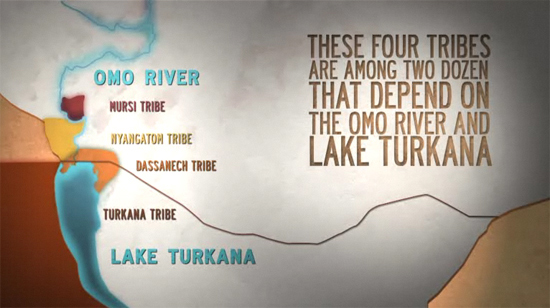
The video focuses on four groups of pastoralists — the Turkana of Kenya and the Dassanech, Nyangatom, and Mursi of Ethiopia — who are among the more than two dozen tribes whose lives and culture depend on the waters of the Omo River and the body of water into which it flows, Lake Turkana. For the past 40 years at least, Lake Turkana has steadily shrunk because of increased evaporation from higher temperatures and a steady reduction in the flow of the Omo due to less rainfall, increased diversion of water for irrigation, and upstream dam projects. As the lake has diminished, it has disappeared altogether from Ethiopian territory and retreated south into Kenya. The Dassanech people have followed the water, and in doing so have come into direct conflict with the Turkana of Kenya.
The result has been cross-border raids in which members of both groups kill each other, raid livestock, and torch huts. Many people in both tribes have been left without their traditional livelihoods and survive thanks to food aid from nonprofit organizations and the UN.
The future for the tribes of the Omo-Turkana basin looks bleak. Temperatures in the region have risen by about 2 degrees F since 1960. Droughts are occurring with a frequency and intensity not seen in recent memory. Areas once prone to drought every ten or eleven years are now experiencing a drought every two or three. Scientists say temperatures could well rise an additional 2 to 5 degrees F by 2060, which will almost certainly lead to even drier conditions in large parts of East Africa.
In addition, the Ethiopian government is building a dam on the upper Omo River — the largest hydropower project in sub-Saharan Africa — that will hold back water and prevent the river’s annual flood cycles, upon which more than 500,000 tribesmen in Ethiopia and 300,000 in Kenya depend for cultivation, grazing, and fishing.
The herdsmen who speak in this video are caught up in forces over which they have no real control. Although they have done almost nothing to generate the greenhouse gas emissions that cause global warming, they may already be among its first casualties. “I am really beaten by hunger,” says one elderly, rail-thin Nyangatom tribesman. “There is famine — people are dying here. This happened since the Turkana and the Kenyans started fighting with us. We fight over grazing lands. There is no peace at all.”
Watch When the Water Ends: Africa’s Climate Conflicts on Yale Environment 360.
For more on integrated PHE development and the Horn of Africa, see “The Beat on the Ground: Video: Population, Health, and Environment in Ethiopia” and “As Somalia Sinks, Neighbors Face a Fight to Stay Afloat,” on The New Security Beat. -
Friday Podcasts
John Bongaarts on the Impacts of Demographic Change in the Developing World
MORE“The UN projects about 9.1 billion people by 2050, and then population growth will likely level off around 9.5 billion later in the century. Can the planet handle 9 billion? The answer is probably yes. Is it a desirable trajectory? The answer is no,” said John Bongaarts, vice president of the Policy Research Division at the Population Council, in this interview with ECSP.
Although family planning was largely brushed aside by international policymakers following the 1994 UN International Conference on Population and Development in Cairo, Bongaarts said he is hopeful because it is now enjoying a higher profile globally – and receiving greater funding.
“I am optimistic about the understanding now, both in developing and developed world, and in the donor community, that [family planning] is an important issue that should be getting more attention,” Bongaarts said. “And therefore I think the chances of ending up with a positive demographic outlook are now larger than they were a few years ago.”
The “Pop Audio” series is also available as podcasts on iTunes. -
Friday Podcasts
Tamara Kreinin on Women’s Empowerment, Population Growth, and Sustainability
MORE“We know that when that when we empower women – whether it’s giving them control over their bodies and access to family planning or whether it’s by including them in planning around climate change – their agency can make huge leaps for us,” said Tamara Kreinin, executive director of women and population at the UN Foundation, in this interview with ECSP.
Seventy percent of the world’s poor are women and they’re also the members of the household most likely to be responsible for food, water, and firewood collection.
“At the same time, we know that women are often not at the table,” she said. “They’re not at the table in country when countries are creating aid to adaptation strategies around the environment and climate change, and they’re not at the table at places like Copenhagen and some of the big climate change meetings.”
The “Pop Audio” series is also available as podcasts on iTunes. -
Watch: Alex Evans on Natural Resource Supply and Demand, Scarcity, and Resilience
October 27, 2010 // By Schuyler Null“The backdrop to the whole issue of scarcity is that demand is rising, but on the supply side, we’re increasingly hitting restraints,” said Alex Evans of NYU’s Center for International Cooperation in this interview with ECSP.MORE
“Global population is growing, a kind of new global middle class is expanding, especially in emerging economies, and that means demand is rising across the board – particularly for energy, for food, water, and air space for our carbon emissions.”
Evans joined Mathew Burrows of the National Intelligence Council this September at the Wilson Center to talk about scarcity, natural resources, and conflict. He argued that building resilience and improving governance of natural resources is key to addressing growing demand, particularly in developing countries.
“With the Millennium Development Goals there’s been tremendous emphasis on increasing access to services, like health and education, which is important,” he said. “But we haven’t always brought the risk management aspect to the fore, and I think the emphasis we’re starting to see now on areas like social protection, climate adaptation, disaster risk reduction – these are areas that are much more concerned with resilience and it’s very welcome that they’re moving to the front of the development agenda.”
Poor governance in some developing countries has resulted in cases like in Nigeria and the Democratic Republic of the Congo, where natural resources are seen as more of a curse to the local people than a blessing. The intersection between supply and demand will continue to make these problems more acute.
“Over the last 10 years when international aid agencies have thought about governance, it’s usually been in terms of capacity building in the executive branch – areas like public financial management,” said Evans. “I think increasingly we’ll see more of the very, very political issues surrounding who owns natural resources like land, or water, or fisheries, or forests.”
Evans also highlighted other international governance issues like transboundary agreements (or lack thereof), the resiliency of the international trade system (or lack thereof), and existing legal infrastructure that will be challenged by a changing climate and growing demand.
“We haven’t really begun to think these issues through,” he said, “but these are potential conflict flashpoints for the future.” -
Friday Podcasts
Christian Leuprecht on Demography, Conflict, and Sub-National Security
MORE“Demographics are going to be to the 21st century what class cleavages were to the 19th century,” said Christian Leuprecht in this conversation with the Environmental Change and Security Program. Leuprecht is an assistant professor at the Royal Military College of Canada and was one of the authors featured in ECSP Report 13.
“Specifically with regards to demography and security, the challenge that I see is at the sub-national level. That is to say that most of the conflict, if you look around the world – the intractable conflicts, the violent conflicts, the conflicts that have been dragging on for decades – tend to be at the sub-national level,” he said. “Yet much of the academic work and the way data are gathered are at the national level.”
The “Pop Audio” series offers brief clips from ECSP’s conversations with experts around the world, sharing analysis and promoting dialogue on population-related issues. Also available on iTunes.Topics: aging, conflict, demography, foreign policy, Friday Podcasts, podcast, population, security, youth -
Eye On
UNFPA State of World Population 2010
Today marks the release of the United Nations Population Fund (UNFPA) annual State of the World Population Report. But the 2010 edition, “From Conflict and Crisis to Renewal: Generations of Change,” is unlike those that have come before. In lieu of the traditional statistic-driven report, this year’s edition has enlisted another tool to document living conditions across the world — storytelling. In addition to demographers, the UNFPA looked to journalists to fan out across the world to gather stories on the ground and paint a portrait of the challenges and opportunities facing today’s global population that goes beyond the numbers, with particular focus on gender issues and human insecurity.MORE
For more on the UNFPA report, be sure to listen to The New Security Beat’s interview with one of its authors, Barbara Crossette, who talks about her experiences dealing with family planning around the world, as part of our ongoing Pop Audio series.
Video Credit: UNFPA.Topics: Africa, aging, Asia, community-based, conflict, demography, environment, Eye On, family planning, gender, global health, population, video, youth -
Friday Podcasts
Barbara Crossette on UNFPA State of the World Population 2010 Report
MORE“Particularly when you go into a society that’s been broken by war or conflict or is so impoverished that is has nowhere to start climbing up, there have to be integrated programs and they have to work with people in mind,” said former New York Times foreign correspondent Barbara Crossette in an interview with The New Security Beat. “The people themselves will solve a lot of the problems around them if they’re just given the tools to do so.”
Crossette is one of the lead authors of the UN Population Fund’s latest State of the World Population Report, “From Conflict and Crisis to Renewal: Generations of Change,” set to launch this Wednesday, October 20th. She spoke to us particularly about the challenges of women around the world and the unique storytelling aspect of this year’s report.
The “Pop Audio” series offers brief clips from ECSP’s conversations with experts around the world, sharing analysis and promoting dialogue on population-related issues. Also available on iTunes.Topics: conflict, development, family planning, Friday Podcasts, gender, global health, maternal health, podcast, population, poverty, UN
 A Publication of the Stimson Center.