-
Flooding in Uttarakhand Shows Why India Needs to Take Environmental Security More Seriously
›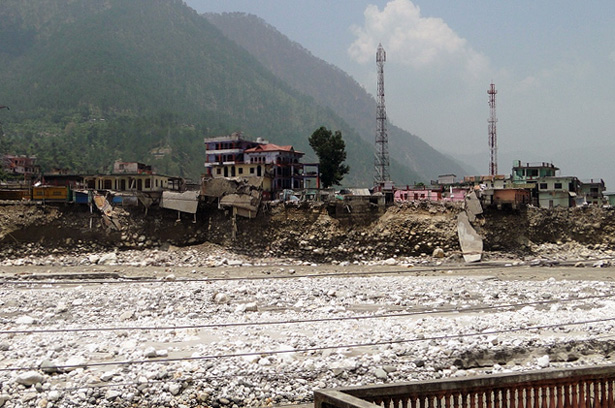
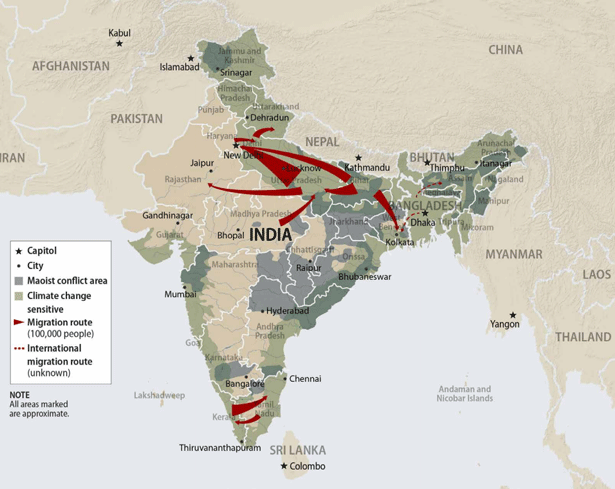
The disastrous flooding in the Himalayan state of Uttarakhand this summer, which claimed more than 6,000 lives, was the outcome of a changing climate and poorly planned development. It was also another case in point of the increasing importance of environmental security in India – especially for the military.
-
India’s Assam Shows Second-Order, Dangerous Effects of Climate Change in South Asia
›August 13, 2013 // By Ashley Ziegler
To use the military parlance, climate change is often considered a “threat multiplier,” challenging stability and development around the world by exacerbating underlying conditions of vulnerability. South Asia is one region that faces multiple stressors that have the potential to feedback off each other.
Higher temperatures, more extreme weather, rising sea levels, flooding, and increased cyclonic activity in the Bay of Bengal and the Arabian Sea are reshaping the environment, warns the Center for American Progress (CAP) in a report.
-
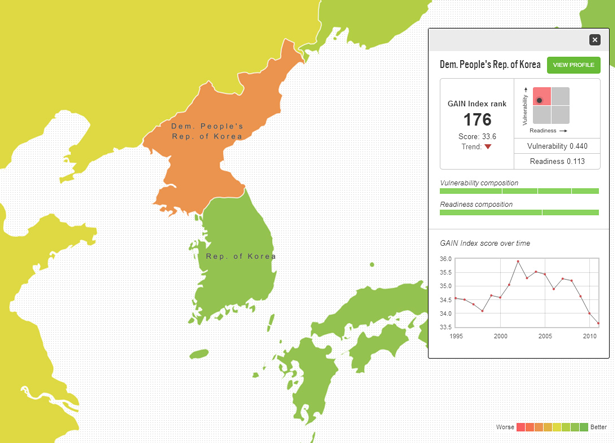
Vulnerability View: GAIN Index Rates Climate Change Preparedness
›According to the UN, the planet has warmed faster since the turn of the century than any other period on record. Sea-level rise has also increased pace to 0.12 inches a year – almost double the rate observed during the 20th century. This “unprecedented” rate of climate change is expected to disproportionally impact developing countries, whose socio-economic, political, and physical landscapes make them particularly vulnerable to the effects. The GAIN Index, an interactive mapping tool recently acquired by the University of Notre Dame, can help policymakers prepare for these changes by comparing the climate change vulnerability and readiness of countries around the world.
-
Lisa Friedman: Bangladesh Shows Importance of Expanding Coverage of Climate-Induced Migration
›“What I found in Bangladesh was that [climate migration] wasn’t a straight line,” says Lisa Friedman in this week’s podcast. It’s “a far more complicated story.”
Friedman is the deputy director of ClimateWire, a news service that brings readers daily information related to climate change and its effects on business and society. At the launch of ECSP’s new report, Backdraft: The Conflict Potential of Climate Mitigation and Adaptation, Friedman discussed her experiences reporting on climate-induced migration in Bangladesh – one of the most vulnerable countries to climate change in the world, due to its low-lying geography, dense population, and high poverty levels.
-
From India to Jordan, Intimate Partner Violence Affects Maternal and Child Health
›Physical, sexual, or psychological harm by a spouse or partner is a major factor in maternal and reproductive health, said Jay Silverman at the Wilson Center last month.
Silverman, a professor of medicine at the University of California, San Diego, cited a 15-country study of both developed and developing countries that found 25 to 75 percent of women have suffered from intimate partner violence at least once. And the effects are very significant, both in terms of the health of mothers and their children. [Video Below]
-
What Does It Take to Cooperate? Transboundary Water Management Around the World
›Water is the foundation of human society and will become even more critical as population growth, development, and climate change put pressure on already-shrinking water resources in the years ahead. But will this scarcity fuel conflict between countries with shared waters, as some have predicted, or will it create more impetus for cooperation?
-
Strengthening Responses to Climate Variability in South Asia
›Climate change and conflict can create a self-reinforcing feedback loop: Climate change exacerbates existing conflicts, while conflict makes adapting to climate change more difficult, said Janani Vivekananda of International Alert at the Wilson Center on February 7. [Video Below]
-
Environmental Migration, Security, and Climate Change
›“Environmental degradation has measurable impacts on migration and presents humanity with unprecedented challenges,” writes Laurence Turbiana in The State of Environmental Migration, edited by François Gemenne and Pauline Brücker of the Institute for Sustainable Development and International Relations and Dina Ionesco of the International Organization for Migration. The report presents the findings of students at the Paris School of International Affairs who examined a number of case studies in 2011, including sudden disasters like the floods in Thailand, Colombia, China, and Bangladesh, as well as slower-onset events like droughts in Somalia and Mexico. The editors conclude that “environmental migration, in its forced and voluntary forms, is a reality.”
Showing posts from category South Asia.