
Showing posts from category natural resources.
-
Conflict Escalates in Resource-Rich South Ossetia
›August 9, 2008 // By Sonia SchmanskiEarlier today, Russian tanks attacked Georgian positions in South Ossetia, the much-disputed Georgian territory sandwiched between Georgia and Russia. With a population of around 70,000, the region has not known peace since the fall of the Soviet Union. Russia’s actions came in response to the Georgian army’s attacks on Russian-backed separatists. Hostilities between Georgian troops and the separatists had been rising since six people died during a skirmish between the two in early July, with Russia and Georgia subsequently accusing each other of violating the ceasefire by flying jets over South Ossetian territory.
The conflict has significant natural resource and environmental aspects. South Ossetia possesses rich stores of natural resources (including timber, manganese, iron ore, and copper and coal deposits), although it remains an economically isolated and depressed region. Also, its location is geopolitically strategic: It houses “[t]wo of the four major border crossings among the mountains separating Russia and Georgia,” along with several other critical roads, and is next to two vital oil pipelines, the Baku-Tbilisi-Ceyhan and the Baku-Supsa, which run from Azerbaijan to Turkey’s Black Sea ports and provide oil for numerous European countries, as well as the United States. These pipelines, in addition to Georgia’s “pivotal role in the global energy market,” render this newest iteration of the conflict cause for international concern.
There are additional environmental concerns in this region. The long-simmering conflict in South Ossetia has left a former Russian industrial complex categorized as “still generating pollution” and a nuclear waste site both untended. With no one to secure, assess, monitor, or remove the hazardous material, regional water sources and arable land are threatened. Lack of economic opportunity in Georgia, and particularly in South Ossetia, has led to illegal logging; “[i]ncentives for illegal export of valuable timber and endemic tree species from the conflict areas…are exacerbating deforestation.”
Economic desperation—combined with a lack of natural resource monitoring—can lead to conflict as people vie for use of a limited resource. A 2004 report from the Environmental Security Initiative (a joint program of UNEP, UNDP, and OSCE) on the South Caucasus region warned that “[u]ncontrolled exploitation of forests, combined with outdated farming practices, are contributing to land degradation and desertification, threatening agricultural productivity.” Indeed, these factors did lead to further trouble for South Ossetia. When Georgia tried to clamp down on “the significant black market trade [in everything from vegetables to illegal arms] going on between South Ossetia and Russia” in 2004, violence quickly re-emerged.
-
2008 Olympics Fuels Burma’s Oppressive Jade Trade
›August 8, 2008 // By Daniel Gleick Four billion people are expected to watch the opening ceremonies of the Olympics today. But what many people may not know is that in an attempt to highlight Chinese heritage, the medals given to victorious Olympic athletes over the next several weeks will include jade—much of which is mined in terrible conditions in neighboring Burma. Although the Beijing Organizing Committee has publicly stated that the medals and officially licensed products are being made with jade from China’s Qinghai Province, not jade from Burma, Blood Jade: Burmese Gemstones & the Beijing Games, a new report by 8-8-08 for Burma and the All Kachin Students and Youth Union maintains that the “showcasing of jade on the world stage will further escalate the growth in demand.
Despite being internationally and internally reviled, Burma’s ruling military junta has been able to maintain its grip on power by controlling the country’s rich natural resources. Burma exports many types of gems, all of which the junta requires be sold through government auctions, where it takes a cut of the profits. BusinessWeek reported that Burma’s official 2006 jade exports totaled $433.2 million, or 10 percent of the country’s total exports. Official tallies are often unreliable, however, and the black market further obscures the true figures.
“In the mining areas, the companies make their own laws,” says a Burmese citizen quoted in the report. Blood Jade tells of mining companies—sometimes with official military support—beating, torturing, and even killing miners who dig through mine waste for discarded stones or make mistakes on the job. “Jadeite production comes at significant costs to the human rights and environmental security of the people living in Kachin state,” says the report. “Land confiscation and forced relocation are commonplace and improper mining practices lead to frequent landslides, floods, and other environmental damage. Conditions in the mines are deplorable, with frequent accidents and base wages less than US$1 per day.”
In an attempt to keep workers on duty for longer hours and to suppress rebellion, the Burmese government has encouraged drug sales and use. The economic situation is so desperate that many women are forced into the sex trade, which the government also condones. The combination of prostitution and drug use has led to disastrous HIV/AIDS rates. “Today,” Blood Jade reports, “four prefectures in Yunnan Province are regarded as having ‘generalized HIV epidemics.’”
Yet despite the misery they cause, jade and other gems are not even the largest single source of income for Burma’s rulers. According to a 2007 article from Foreign Policy, two other resources rate higher: natural gas and the tropical hardwood teak, which is so valuable that it has “perpetuated violent conflicts among the country’s many fractious ethnic groups.”
Several groups have organized campaigns urging people not to buy jade products, but it is unclear what impact they will have on the trade. Following the junta’s crackdown on anti-government protests by Buddhist monks in November 2007, a representative of Kam Wing Cheong Jewelry in China told BusinessWeek: “We will not stop purchasing stones in Burma because of the political situation. The political chaos did not start with the junta; the country has been plagued by the conflicts with ethnic minorities for years. This is totally out of our control.”
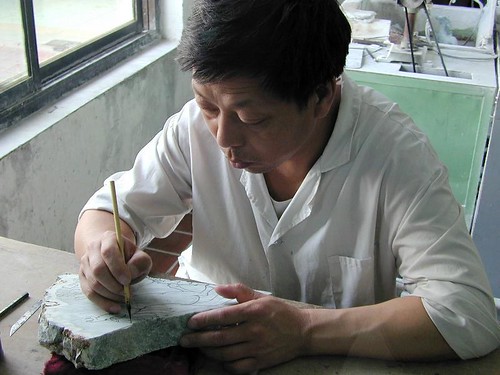
Photo: Man working in a jade factory in China. Courtesy of Flickr user maethlin -
Weekly Reading
›“The term ‘climate refugees’ implies a mono-causality rarely found in human reality,” argue the authors of a report on climate change and forced migration released by the Norwegian Refugee Council. The report’s authors urge additional research on the links between climate change, migration, and conflict, and strongly emphasize the importance of helping developing countries adapt to climate change’s impacts.
According to a report released by the Internal Displacement Monitoring Centre of the Norwegian Refugee Council, the number of internally displaced persons (IDPs) reached 26 million in 2007, despite an overall decline in the number of violent conflicts around the world.
The Philippine government reached a deal with a Muslim rebel group that will expand an autonomous region in the southern Philippines. “The proposed homeland will be entitled to a large share of the resources in the area,” reports the BBC. -
Fish Out of Water
›July 31, 2008 // By Daniel Gleick“If you want fast money and are willing to take the risk, that’s the only way to get it,” says Abdullah Dieng, a fisherman in Bissau, Guinea, in a new IRIN article, “Fishermen turn to trafficking as fish profits drop.” Fishermen in Guinea have a problem: No one is buying their fish. “The lack of decent roads into the interior of the country, combined with prohibitive fuel prices, makes it too difficult for fish-sellers to transport fish any further than Bissau, creating a saturated market,” reports IRIN. As an alternative, the fishermen are turning to illegal trade in drugs and humans. By smuggling, they can earn much more money.
“The UN Office on Drugs and Crime estimates several hundred kilograms of cocaine go through the country each week, while according to 2004 figures from the International Office of Migration, one million West and Central Africans head clandestinely to Europe every year,” reports IRIN.
Fisheries are collapsing all over the world, but especially in Africa. The New York Times article “Europe Takes Africa’s Fish, and Boatloads of Migrants Follow” reports that there is almost no regulation of Bissau’s fishery, like most fisheries along the African coast. “Creating the Enabling Environment for Effective Fisheries Enforcement,” an event in the Environmental Change and Security Program’s fisheries series, explored some of the challenges associated with fisheries management. One of the most basic problems is a lack of information. Vladimir Kacyznski, a marine scientist with the University of Washington, told the Times that “no one has comprehensively studied the nation’s coastal waters for at least 20 years.” As a result, both local and European fishers have mostly stripped the area of its fish.
The lack of oversight is largely due to a lack of attention, and thus a lack of money. IRIN reports that “The fishing ministry receives just 5 percent of the government’s paltry annual budget, despite fishing bringing in 40 percent of the country’s annual revenues, and most of this money can only cover staff salaries.” Without increased funding and attention, it is unlikely that a solution will emerge to the environmental and economic problems that force fishermen to turn to illegal and dangerous activities. As the source of their livelihoods disappears, they have fewer and fewer options. Said one consultant quoted in the Times story, “The sea is being emptied.” -
Climate Change, Natural Disasters Disproportionately Affect Women, Report Finds
›July 31, 2008 // By Sonia SchmanskiWomen “are the most likely to bear the heaviest burdens when natural disasters strike,” says a new report from the Women’s Environment and Development Organization (WEDO), “Gender, Climate Change and Human Security: Lessons from Bangladesh, Ghana and Senegal.” The report also encourages governments to allow women to play larger roles as agents of preparedness, mitigation, and adaptation.
Climate change, the report says, “forms a major threat to human security at national and livelihood levels.” Because 70 percent of people living below the poverty line are women, their livelihoods are threatened most acutely by climate change and the natural disasters it is likely to make increasingly frequent and severe. In addition, women are often responsible for “tasks such as food collection and energy supply for the household as well as many care-giving tasks, such as caring for the children, sick, elderly, the home and assets.” In the wake of a natural disaster, these activities can become nearly impossible, and being responsible for them can prevent women from migrating from disaster zones, despite the burden of living where disaster has struck. This migration, the authors write, has significant impacts on those who stay as well as those who leave, as “the relocation of people has severe impacts on social support networks and family ties—mechanisms that have a crucial value for women.”
Losing over half a million citizens to natural disasters between 1970 and 2005 has given Bangladesh the highest disaster mortality rate in the world, and gender-neutral data collection makes it difficult to determine gender-specific outcomes. From the data that does exist, the report notes that following the cyclone and flood disasters of 1991, for example, the death rate among adult women (20-44 years of age) was 71 per 1000, almost five times higher than the rate of 15 per 1000 for adult men.
There is consensus that South Asia is among the regions most affected by climate change, the report says, and that Bangladesh is the most vulnerable country in the region. For the 80 percent of Bangladeshi women who live in rural areas and are solely responsible for water and firewood collection, food preparation, and family health care, the future appears increasingly imperiled.
A study published last year in the Annals of the Association of American Geographers confirmed that natural disasters decrease the life expectancy of women much more dramatically than men; that the more intense the disaster, the stronger this effect; and that the wealthier the women, the less they are affected by this phenomenon.
Even as women suffer disproportionately from climate change and natural disasters, the report says, “women are more often overlooked as potential contributors to climate change solutions,” and their ability to contribute to preparation, mitigation, and rehabilitation efforts is undervalued. The report recommends that countries develop National Adaptation Programmes of Action (NAPAs) that involve women as contributors to adaptation processes and work toward “improving human security in the context of climate change from a gender perspective.”
-
Weekly Reading
›“Women are key to the development challenge,” says Strategies for Promoting Gender Equity in Developing Countries, but “gender mainstreaming has been associated with more failures than gains.” Detailing findings from an April 2007 conference co-sponsored by the Wilson Center and the Inter-American Foundation, the report calls for a redesigned approach operating on multiple fronts. Blogging about the report, About.com’s Linda Lowen dubs the gap between women and men in developing countries a “Grand Canyon-like divide” compared to the “crack in the sidewalk” faced by Western women.
A Council on Foreign Relations backgrounder on Angola—now Africa’s leading oil producer—tackles the familiar paradox of extreme poverty in resource-rich countries. Burdened by “an opaque financial system rife with corruption,” Angola’s leaky coffers are filling up with Chinese currency. As Angolan President Jose Eduardo dos Santos put it, “China needs natural resources, and Angola wants development.” FastCompany.com’s “Special Report: China In Africa” criticizes the overwhelming Chinese presence in Africa: “The sub-Sahara is now the scene of one of the most sweeping, bare-knuckled, and ingenious resource grabs the world has ever seen.”
In Scientific American’s “Facing the Freshwater Crisis,” Peter Rogers writes that the demands of increasing population, along with increasingly frequent droughts due to climate change, signal rough waters ahead, and calls for major infrastructure investments to prevent catastrophe. Closer to home, Circle of Blue reports on a new era of water scarcity in the United States, and director Jim Thebaut’s documentary “Running Dry: The American Southwest” takes a look at the hard-hit region.
Pastoralists are socially marginalized in many countries, making them highly vulnerable to climate change despite their well-developed ability to adapt to changing conditions, reports the International Institute for Environment and Development in “Browsing on fences: Pastoral land rights, livelihoods and adaptation to climate change.” The paper notes that the “high rate of development intervention failure” has worsened the situation, and calls for giving pastoralists “a wider range of resources, agro-ecological as well as socio-economic,” to protect them.
-
Food, Fish, and Fighting: Agricultural and Marine Resources and Conflict
›July 23, 2008 // By Daniel Gleick“Over the past two decades, the extraction and trade of natural resources have helped incite, fuel and prolong violent conflicts,” write Alec Crawford and Oli Brown in Growing Unrest: The links between farmed and fished resources and the risk of conflict, a new report by the International Institute for Sustainable Development. “The links between natural resources and conflict are established and widely accepted,” point out the authors; however, “it has become ‘received wisdom’ that these linkages only apply to a certain subset of natural resources—oil, diamonds, certain minerals (e.g., coltan), illegal narcotics and timber.” This notion is mistaken, as agriculture and fisheries are also often involved in funding and instigating conflict.
The authors highlight four case studies before making general policy recommendations. In the Côte d’Ivoire, instabilities in the cocoa market during the 1980s exacerbated social tensions, eventually leading to civil war. During this war, both sides taxed cocoa transport or production to finance their war effort.
In Somalia, where limited ports make it easy to control exports, a tax on bananas was a significant source of income for many Somali warlords during the 1990s. In present-day Somalia, many warlords have turned to the fishing market, funding local militias by issuing false fishing licenses to foreign companies for millions of dollars.
The final case examines the tensions over water-sharing agreements in Central Asia between Kazakhstan, Kyrgyzstan, Tajikistan, Turkmenistan, and Uzbekistan. Water necessary for irrigating cotton, the local economic staple, has been a contentious issue for years, and resolution has not been forthcoming even as irrigation infrastructure continues to decay.
Based on these case studies, the authors report three main findings:
• By controlling the trade of agricultural or marine commodities, gangs, warlords, or sovereign nations can extract wealth and use it to support conflicts and other oppressive activities.
• When the prices of farmed and fished goods are volatile, they can lead to instability and conflict in nations without stable markets or political systems.
• Agricultural and marine goods can be seen as “proxies” for more basic commodities, such as freshwater and land — and thus part of larger conflicts over those resources.
The report offers 14 recommendations — falling into two general categories — for policymakers hoping to minimize conflict over these resources. It recommends expanding existing structures – such as extending sanctions that currently punish those who use diamonds, oil, coltan, and other natural resources to fund conflict – to include agricultural and marine commodities. It also recommends stabilizing dangerous situations, such as easing institutional tensions when faced with shortages or conflicting interests, or cracking down on opportunities for exploitation caused by price volatility.
Those interested in natural resources and conflict should expand their focus to fished and farmed resources instead of remaining trapped in a worldview in which only certain commodities are important. The authors write, “It is not the type of resource that matters, but rather how it is produced and traded, to what ends the revenues are put, and what the associated impact is on people and their environments.”
ECSP examined the challenges facing the world’s fisheries in a recent meeting series available at www.wilsoncenter.org/fish. An ongoing series looks at natural resources and conflict: www.wilsoncenter.org/newhorizons.
-
Population-Health-Environment Video Featuring Lori Hunter Now on YouTube
›July 18, 2008 // By Sean Peoples“Population, Health, and Environment: Exploring the Connections,” an original ECSP video, offers a lively, brief, and accessible explanation of population-health-environment connections, with examples and photos from successful programs in the Philippines. Presenter Lori Hunter of the University of Colorado, Boulder, spoke at the Wilson Center earlier this year as part of ECSP’s PHE meeting series. View the video on YouTube, then rate it, comment on it, favorite it, or post a video response.