

-
Weekly Reading
›“Climate change of that scale [a 5° C increase] will cause enormous resource wars, over water, arable land, and massive population displacements. We’re not talking about ten thousand people. We’re not talking about ten million people, we’re talking about hundreds of millions to billions of people being flooded out, permanently,” said Steven Chu, President-elect Barack Obama’s choice for secretary of energy, at the National Clean Energy Summit this summer.
“As the world focuses on the outcomes of the meeting on climate change that just concluded in Poznan, Poland, I am sitting in a workshop in Nazret, Ethiopia, listening to a panel of farmers talking about the effects of climate change on their lives – less rain, lower crop yields, malaria, no milk for their children,” writes Karen Hardee on Population Action International’s blog. “They are acutely aware that farm sizes shrink with each generation and speak eloquently of the need for access to family planning so they can have fewer children.”
The New York Times reports on the fight for control over uranium deposits in northern Niger, part of its ongoing series on resource conflict.
The current volume of Global Governance: A Review of Multilateralism and International Organizations examines global water governance.
On the Carnegie Council’s “Policy Innovations” website, Rebecca Laks reports on efforts to incorporate alternative fuels into refugee camps in order to reduce deforestation in the surrounding environment.
The Center for American Progress has released “Putting Aid and Trade to Work: Fostering Development for Sustainable Security,” along with related documents.
The Sabaot Land Defence Force and the Kenyan army have been fighting over the rights to land in western Kenya for years, and local women are suffering, reports IRIN News. Fighters from both sides often rape women, giving them HIV/AIDS.
“Cleaning the environment has been identified as major tool in waging war against mosquitoes” and malaria in Nigeria, reports the Vanguard. -
Weekly Reading
›The U.S. Army’s first annual sustainability report details its environmental “bootprint.” It reveals that the Army reduced its facility energy intensity use by 8.4 percent from FY04-FY07, but increased its hazardous waste generation by 35 percent from 2003-2006. The New York Times’ Green, Inc. blog weighs in.
The Economist’s “The World in 2009” features a special section on the environment. UN Under-Secretary-General Sir John Holmes discusses the urgency of preparing for and responding to climate change-related disasters, while Peter Brabeck-Letmathe, chairman of Nestle, highlights the links between water scarcity, agriculture, and biofuels.
The Year of the Gorilla 2009, a project of the United Nations, will promote low-volume wood-burning stoves, ecotourism, anti-poaching projects, and human health care in an effort to save endangered gorillas. Gladys Kalema-Zikusoka, founder of Ugandan NGO Conservation Through Public Health (CTPH), describes CTPH’s efforts to protect mountain gorillas through human health care and family planning, community outreach and education, and support for alternative livelihoods.
“While policymakers, wedded to an outmoded worldview, fret about what Arctic climate change might do to national power directly in the basin, human wellbeing could be devastated around the world by cascading consequences of shifts in the Arctic’s energy balance,” writes Thomas Homer-Dixon in “Climate Change, the Arctic, and Canada: Avoiding Yesterday’s Analysis of Tomorrow’s Crisis.” “Ironically, these changes could – in the end – do far more damage to state-centric world order and even to states’ narrowly defined interests than any interstate conflicts we might see happen in the newly blue waters of the Arctic.”
A new paper from the Stockholm International Peace Research Institute explores the links between mining and conflict in the Democratic Republic of the Congo (DRC) and Sierra Leone.
Diamonds and Human Security: Annual Review 2008 examines the socio-political impacts of diamond extraction in 13 countries, including the DRC, Sierra Leone, Angola, and Cote d’Ivoire.
Former ECSPer and current freelance writer Ali Gharib dissects “greenocons,” arguing that “the apparent convergence of the right-wing with environmentalism, typically a politics of the left, is complex and conflicted.” -
Sustaining the Environment After Crisis and Conflict
›December 4, 2008 // By Rachel Weisshaar “Unfortunately, disasters are a growth industry,” said Anita Van Breda of the World Wildlife Fund (WWF) at “Sustaining Natural Resources and Environmental Integrity During Response to Crisis and Conflict,” a November 12 meeting sponsored by the Wilson Center’s Environmental Change and Security Program. But the impact of increased disasters on the environment is not a priority for first responders: According to Charles Kelly, an affiliate of the Benfield Hazard Research Centre at University College London, their perspective is, “How many lives is it going to save, and how much time is it going to take?” Environmentalists, who tend to think in terms of decades and generations, can find it difficult to communicate effectively with aid workers. “You give a 30-page report and it’s not going to be read, and there’s going to be no action,” said Kelly.
 -
Natural-Resource, Demographic Pressures Collide With Political Repression as Guinea Reaches Potential Breaking Point
›December 3, 2008 // By Will Rogers“We have had enough of false promises” from the government, said one resident of the northwestern Guinean mining town of Boké, a sentiment shared by many of his countrymen. Long ruled by self-serving autocrats, members of this predominantly youthful society, angered by their lack of access to basic services like electricity, water, and education, have ramped up demonstrations against the central government in Conakry.
Despite its extensive reserves of bauxite—the ore from which aluminum is produced—Guinea, ranked 160 out of 177 countries in the United Nation’s Human Development Index, has long been plagued by underdevelopment and poverty. Pockets of protests have erupted throughout the country over the past two years, with the frequency increasing in recent weeks in response to high fuel prices and continuing lack of access to basic services such as water and electricity. President Lansana Conté has regularly dispatched state security forces to crack down on protesters, and these forces have murdered, raped, beaten, tortured, and unlawfully imprisoned unarmed demonstrators and bystanders. “There is a tremendous amount of frustration and anger in Guinea,” Corrine Dufka, a researcher with Human Rights Watch, told the New York Times. “People protest to express that anger, and security forces respond with excessive force.”
Given Guinea’s very young age structure—46 percent of its population is younger than 15—violent suppression by the central government heightens the already-high risk that the country will devolve into civil war. According to Elizabeth Leahy in The Shape of Things to Come: Why Age Structure Matters to a Safer, More Equitable World, presented at a 2007 Wilson Center event, Guinea, like other countries with very young age structures—including the Democratic Republic of the Congo, Haiti, and Uganda—is three to four times more likely to experience civil conflict than countries with more balanced, mature age structures, like the United States. And with the global economic downturn expected to take a devastating toll on the developing world, Guinea may soon find itself embroiled in conflict if the government maintains its violent tactics and fails to provide the services Guineans need.
Photo: In the capital of Conakry, demonstrations fueled by lack of opportunity and civil services have continued unabated despite violent repression by the central government. Courtesy of flickr user martapiqs. -
Coltan, Cell Phones, and Conflict: The War Economy of the DRC
›December 2, 2008 // By Will RogersEclipsed by the world economic downturn, the great heist of the Democratic Republic of the Congo’s (DRC) resources continues unabated. In recent weeks, former Congolese General Laurent Nkunda’s Tutsi rebels have launched offensives in North Kivu, and the Congolese army and UN peacekeepers have been hard-pressed to stop them.
With some of the world’s greatest reserves of minerals, metals, natural gas, and oil—including 10 percent of global copper reserves and 33 percent of global cobalt reserves, in addition to vast deposits of diamonds, gold, silver, timber, uranium, and zinc—eastern DRC has frequently been exploited by rebel groups, foreign militaries, and international firms looking to fill their coffers. Other African conflicts have been sustained by diamonds and gold, but in the eastern DRC, columbo-tantalite (coltan), is one of the most coveted commodities. And with 80 percent of global reserves of coltan lying in the DRC, coltan has become the new “black gold”.
Coltan is refined into tantalum powder to make heat-resistant capacitors in cell phones, laptops, and other high-end electronics. With global technological innovation on the rise, the demand for the mineral continues to surge, creating the incentive for miners and traders to step up their efforts to extract it. At its peak in September 2001, coltan traded at close to $400 per kilo; today, the market price has steadied at around $100 per kilo.
Struggle for control over coltan mines remains central to the conflict in eastern DRC, which has claimed more than four million lives over the past decade. Whether it is a Hutu militia like the Democratic Forces for the Liberation of Rwanda (FDLR), which fled Rwanda< following the 1994 genocide; a Congolese rebel faction, like Nkunda’s Tutsi rebels; or the Congolese army itself, each has a stake in the lucrative coltan trade.
These groups, including the Congolese army, have been active in extorting coltan miners, as demonstrated by footage from “Blood Coltan.” With coltan miners earning $10 to $50 a week, five times more than most other Congolese earn in a month, government and rebel troops have taxed the miners for access to the mines—making control of the mines and surrounding land violently competitive. Despite the dangerous conditions of the mines, which have led to countless deaths, workers remain plentiful. And as demand for coltan has increased in recent years, the number of child laborers in the mines has grown, with approximately 30 percent of schoolchildren in the region deferring their education for mining work.
In addition to the human toll, coltan exploitation has also proven severely destructive to the region’s environment and biodiversity. North and South Kivu provinces contain the DRC’s greatest concentrations of coltan, and Kahuzi Biega National Park (KBNP), one of the last sanctuaries for the critically endangered eastern lowland gorilla, spans both provinces. Coltan mining has destroyed much of the gorillas’ natural habitat, leaving them vulnerable to poachers who kill them and sell them to coltan miners and rebel groups for food. According to park surveys, the population of eastern lowland gorillas in KBNP plummeted from 8,000 in 1991 to approximately 40 in 2005.
DRC Ambassador to the United States Faida Mitifu, speaking recently at a U.S. Institute of Peace event, urged the U.S. Congress to adopt what she describes as a Kimberly Process for coltan in an effort to end the illegal export of coltan from eastern DRC. A “Goma Process” could certify the origin of coltan and place punitive levies on those involved in the trade of conflict coltan from eastern DRC—much as the Kimberly Process does for diamonds. Meanwhile, building infrastructure and creating a regulated sustainable resource extraction industry could also help the country generate much needed revenue and profitable trade regimes. But given that coltan is smuggled into Rwanda and other bordering countries and traded to non-U.S. markets, the support of the international community and the UN Security Council would be critical to the success of this initiative and creating a lasting peace in the region. The UN Security Council has already condemned coltan’s role in financing conflict, so the creation of a Goma Process could be a logical—and achievable—next step.
Photo: In this makeshift refugee camp in Mugunga, 10 kilometers from Goma in North Kivu, tens of thousands remain displaced by ongoing conflict in eastern DRC. Courtesy of flickr user Julien Harneis. -
Population-Health-Environment Effort Launched in American Samoa
›The government of American Samoa has decided to boldly address the issue of rapid population growth, due to its potentially severe environmental impacts on the territory. Governor Togiola Tulafono’s Coral Reef Advisory Group, for which I work, has identified population pressure as the single largest threat to American Samoa’s coastal resources. This is an important finding because all of American Samoa’s population lives along the coast, and the entire territory is considered a coastal zone.
The government recently hosted a Population Summit with more than 130 key stakeholders to discuss the problems and to devise collaborative solutions. Governor Tulafono opened the summit by stating that “resources are not finite—there are limits—and in an island setting as ours, the primary threat comes from people and how they behave responsibly in their use of land, water and air.” Participants developed a Population Declaration containing numerous policy initiatives, project proposals, and a recommendation to create a Population Commission. This declaration was presented to the legislature and Governor Tulafono for their consideration. American Samoa recently held elections, and the new government will be sworn in come January, at which point the working team I coordinate will be pressing the government to implement this important call to action.
Population-health-environment (PHE) activities are still in their infancy in American Samoa. However, we do have some projects underway. The most progress so far has been with local education and outreach efforts. I am working with one of our local environmental educators to develop PHE lesson plans and activities for local schools. We will be advertising these lesson plans in the local newspaper and informing teachers that our staff are available to come to their schools to introduce these issues. In addition, we are developing a number of PHE educational resources to distribute at schools we visit.
Family planning clinic staff and environmental educators have begun collaborating on a weekly radio series on the issue of rapid population growth. These discussions are raising the awareness of listeners and encouraging them to be good stewards of their health and their environment. In addition, a team of educators is planning the first annual World Population Day event here next year.
On the policy side, we are collaborating with the various agencies, planning departments, and staff from the Secretariat of the Pacific Community to develop a Territorial Population Policy. Once this is developed, American Samoa will be one of only three island states in the South Pacific with such a policy. This policy is still in the early stages of being written, but I am confident that a draft will be developed over the coming year.
Finally, American Samoa is ramping up its marine-protected-area efforts, especially the Department of Marine and Wildlife Resources’ community-based fisheries management program, which is an ideal venue for integrating population and environmental efforts. One of my main focus areas over the coming year will be looking at how I can connect the ongoing Department of Health activities with these programs. Although we are still in the early stages of addressing PHE issues in American Samoa, I am hoping to use the momentum from the recent summit to get us up to speed as quickly as possible.
Alyssa Edwards, a former ECSP intern, is the population pressure local action strategy coordinator with the Coral Reef Advisory Group in American Samoa.
Photo: Samoan schoolchildren play on a truck. Courtesy of Alyssa Edwards. -
PODCAST – Lester Brown on Climate Change and Energy Security
›November 13, 2008 // By Wilson Center Staff“When looking at what we need to do, I think stabilizing climate, stabilizing population are the two big ones. If we fail at either of those…civilization is in serious trouble,” warns Lester Brown, founder of the Earth Policy Institute in Washington, DC, in the latest podcast from the Environmental Change and Security Program (ECSP). Following a recent event, “Thinking Outside the Grid: An Aggressive Approach to Climate and Energy,” co-sponsored by Wilson Center on the Hill and ECSP, Brown elaborated on the themes of his latest book, Plan B 3.0: Mobilizing to Save Civilization, and addressed climate change’s impact on natural resources, food security, and energy independence. He argues that the United States must critically re-examine its energy infrastructure and invest heavily in alternative energy technologies. -
Fertile Fringes: Population Growth Near Protected Areas
›November 7, 2008 // By Rachel Weisshaar“Protected areas are the backbone of biodiversity conservation strategies,” so it is critical to examine how population growth is affecting them, said Justin Brashares of the University of California, Berkeley, at “Fertile Fringes: Population Growth at Protected-Area Edges,” an October 22, 2008, meeting sponsored by the Environmental Change and Security Program (ECSP). “Biodiversity conservation objectives are being impacted by higher deforestation rates, [natural resource] offtake rates, [and] increasing pressure on the protected area” due to high local population growth, explained George Wittemyer of Colorado State University. Brashares and Wittemyer, who recently co-authored an article on population and protected areas in Science, were joined by Jason Bremner of the Population Reference Bureau.
To Stay or To Go?
“Many of the protected areas that we have today in sub-Saharan Africa and in Latin America are carryovers of areas set aside by colonial governments,” said Brashares, “and for many researchers and for many communities, the creation of parks is seen to come at the cost of local communities.” Yet certain features can encourage people to move near protected areas, including:- Services made available by foreign assistance, such as health care, education, and livelihoods programs;
- Employment opportunities as park staff or in the tourism industry;
- Better ecosystem services, including food, water, wood, and traditional medicine;
- Easier access to markets, due to roads built to attract tourism; and
- Improved security provided by park guards and government staff.
Other features of protected areas deter migrants, including:
- Land-use restrictions;
- Conflict with wildlife (e.g., attacks on livestock and crops);
- Disadvantages associated with tourism, including higher cost of living and potential loss of cultural heritage;
- Isolation from urban centers; and
- Conflict with park staff, government representatives, or rural militias.
Higher Population Growth Near Protected Areas
Brashares and Wittemyer examined IUCN Category I and II protected areas in Africa and Latin America—which limit human activity within their boundaries—and excluded potentially confounding urban, marine, and new parks. Using UN Environment Programme population data from 1960-2000, they compared population growth in a 10-kilometer “buffer zone” surrounding each protected area with average rural population growth for that country. In 245 of the 306 parks they examined—and 38 of the 45 countries—population growth at protected-area edges was significantly higher than average national rural population growth.
Brashares and Wittemyer found three factors correlated with higher levels of population growth: more money for parks (as measured by protected-area funds from the Global Environment Facility); more park employees; and more deforestation on the edges of protected areas. Brashares emphasized, however, that there could be equally relevant correlations between population growth and employment in extractive industries, but that “the timber industry won’t give us their data and the mining industry and the oil industries aren’t so happy to share.” Thus, the study might inadvertently penalize NGOs and international organizations for their transparency.
Some researchers hypothesized that because protected areas are usually located in ecologically dynamic areas, this ecological wealth might be attracting new residents, rather than the protected areas themselves. But Brashares and Wittemyer found that proximity to a protected area, not general ecological abundance, was driving the trend. Others suspected that population grows at protected-area edges because the people who have been displaced by the creation of a park move to the park’s border. But population growth rates within the parks have been mostly stable or positive, so Brashares and Wittemyer doubt this is driving the trend.
Implications for Conservation
Brashares and Wittemyer outlined several policy implications of their research:- Emerging infectious diseases are a serious risk in areas with high human density close to wildlife populations, so governments and international organizations should try to limit potential outbreaks near protected areas.
- If the effectiveness of a protected area is measured by its ability to preserve biodiversity for generations, then community development programs must be executed carefully. For instance, roads and schools should not be built in an ecologically fragile corridor between two parks.
- Multi-use buffer zones that make core areas less accessible can allow individuals to continue to benefit from their proximity to nature while protecting biodiversity. “Some of the best protection of biodiversity is through isolation,” said Brashares.
Bremner took issue with some of Brashares’ and Wittemyer’s methods and conclusions; his full critique is available on the New Security Beat. Although Bremner agreed that migration—not natural increase—is likely driving higher population growth around protected areas, he believed the authors did not provide adequate evidence to demonstrate that this migration is driven by investments in conservation. “I hope that publishing this conclusion here in Science doesn’t provide our detractors, those who don’t want us to be spending on conservation, with the means to limit future spending for international conservation,” said Bremner.
Photo: Justin Brashares. Courtesy of Dave Hawxhurst and the Woodrow Wilson Center.
For more information, including a webcast of this event, visit ECSP’s website. To receive invitations to future events, e-mail ecsp@wilsoncenter.org.
Showing posts from category natural resources.
 “Unfortunately, disasters are a growth industry,” said Anita Van Breda of the World Wildlife Fund (WWF) at “
 Eclipsed by the world economic downturn, the great heist of the Democratic Republic of the Congo’s (DRC) resources continues unabated. In recent weeks, former Congolese General Laurent Nkunda’s Tutsi rebels have
  The government of American Samoa has decided to boldly address the issue of rapid population growth, due to its potentially severe environmental impacts on the territory. Governor Togiola Tulafono’s
 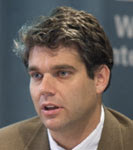 “Protected areas are the backbone of biodiversity conservation strategies,” so it is critical to examine how population growth is affecting them, said Justin Brashares of the University of California, Berkeley, at “Fertile Fringes: Population Growth at Protected-Area Edges,” an October 22, 2008, meeting sponsored by the Environmental Change and Security Program (ECSP). “Biodiversity conservation objectives are being impacted by higher deforestation rates, [natural resource] offtake rates, [and] increasing pressure on the protected area” due to high local population growth, explained George Wittemyer of Colorado State University.

