

Showing posts from category natural resources.
-
New Director of National Intelligence Assesses Climate, Energy, Food, Water, Health
›February 18, 2009 // By Rachel WeisshaarIn the annual threat assessment he presented last week to the Senate Select Committee on Intelligence, new Director of National Intelligence Dennis Blair named the global economic crisis—not terrorism—the primary near-term threat to U.S. national security, prompting accusations of partisanship from the Washington Times. Yet as the U.S. Naval War College’s Derek Reveron notes, “the economic turmoil of the early 20th century fueled global instability and war,” and today’s economic collapse could strengthen extremists and deprive U.S. allies of the funds they need to deploy troops or increase foreign assistance to vulnerable regions.
Further down the list of potential catastrophes—after terrorism, cybersecurity, and the “arc of instability” that stretches from the Middle East to South Asia—the assessment tackles environmental security threats. The four-page section, which likely draws on sections of the recent National Intelligence Council report Global Trends 2025: A Transformed World, summarizes the interrelated natural-resource and population challenges—including energy, food, water, demography, climate change, and global health—the U.S. intelligence community is tracking.
The world will face mounting resource scarcity, warns Blair. “Access to relatively secure and clean energy sources and management of chronic food and water shortages will assume increasing importance for a growing number of countries. Adding well over a billion people to the world’s population by 2025 will itself put pressure on these vital resources,” he writes.
Drawing on the conclusions of the 2008 National Intelligence Assessment on the impacts of global climate change to 2030, Blair portrays climate change as a variable that could place additional strain on already-stressed agricultural, energy, and water systems: “We assess climate change alone is unlikely to trigger state failure in any state out to 2030, but the impacts will worsen existing problems such as poverty, social tensions, environmental degradation, ineffectual leadership, and weak political institutions.” Direct impacts to the United States include “warming temperatures, changes in precipitation patterns, and possible increases in the severity of storms in the Gulf, increased demand for energy resources, disruptions in US and Arctic infrastructure, and increases in immigration from resource-scarce regions of the world,” writes Blair.
Africa, as usual, is the last of the world’s regions to be analyzed in the assessment. Blair notes that “a shortage of skilled medical personnel, deteriorating health systems, and inadequate budgets to deal with diseases like HIV/AIDS, malaria, and tuberculosis” is threatening stability in sub-Saharan Africa, and explains that agriculture, which he rightly calls “the foundation of most African economies,” is not yet self-sufficient, although some countries have made significant improvements in infrastructure and technology. He highlights ongoing conflicts in the Democratic Republic of the Congo, Nigeria, Sudan, and Somalia as the most serious security challenges in Africa. He fails to note, however, that all four have environmental/natural resource dimensions (see above links for details). -
Weekly Reading
›Conflicts among pastoralists over water and land have increased in drought-stricken northeastern Kenya, reports IRIN News.
Country for Sale, a report by Global Witness, alleges that Cambodia’s oil, gas, and mineral industries are highly corrupt.
Foreign Policy features an interview with General William “Kip” Ward, the commander of the new U.S. Africa Command. The New Security Beat covered General Ward’s recent comments on civilian-military cooperation.
Healthy Familes, Healthy Forests: Improving Human Health and Biodiversity Conservation details Conservation International’s integrated population-health-environment projects in Cambodia, Madagascar, and the Philippines.
Double Jeopardy: What the Climate Crisis Means for the Poor, a new report on climate change and poverty alleviation, synthesizes insights from an August 2008 roundtable convened by Richard C. Blum and the Brookings Institution’s Global Economy and Development Program at the Aspen Institute.
“Although the long-term implications of climate change and the retreating ice cap in the Arctic are still unclear, what is very clear is that the High North is going to require even more of the Alliance’s attention in the coming years,” said NATO Secretary General Jaap de Hoop Scheffer at a seminar on security prospects in the High North hosted by the Icelandic government in Reykjavik.
“I think we will work our way towards a position that says that having more than two children is irresponsible. It is the ghost at the table. We have all these big issues that everybody is looking at and then you don’t really hear anyone say the “p” word,” says UK Sustainable Development Commission Chair Jonathon Porrit, speaking about population’s impact on the environment. Porrit has drawn criticism for his remarks.
A local priest has warned that a Norwegian company’s proposed nickel mines will threaten food security on the Philippine island of Mindoro. -
Watch: Peter Gleick on Peak Water
›February 5, 2009 // By Wilson Center Staff“The concept of ‘peak water’ is very analogous to peak oil…we’re using fossil groundwater. That is, we’re pumping groundwater faster than nature naturally recharges it,” says Peter Gleick in this short expert analysis from the Environmental Change and Security Program. Gleick, president and co-founder of the Pacific Institute and author of the newest edition of The World’s Water, explains the new concept of peak water.
-
VIDEO: Jim Jarvie on How Humanitarian Groups Are Responding to Climate Change
›February 5, 2009 // By Wilson Center Staff“We recognize that in dealing with climate change, what we do is modest….But unless we get the message out and find partners who can really take it to large scale, our efforts aren’t futile, but they’re of little value over the next 30 to 50 years, which is indeed the time frame we ought to be thinking on,” says Jim Jarvie in this short expert analysis from the Environmental Change and Security Program. Jarvie, director of climate change, environment, and natural resources at Mercy Corps, discusses why humanitarian development organizations must respond to new climate challenges. -
United States Elevates Arctic to National Security Prerogative
›January 16, 2009 // By Will Rogers “The United States has broad and fundamental national security interests in the Arctic region and is prepared to operate either independently or in conjunction with other states to safeguard these interests,” states National Security Presidential Directive 66 (NSPD-66), issued by President Bush on Monday. NSPD-66 does pay some attention to “softer” Arctic issues, such as environmental protection, international scientific cooperation, and the involvement of the Arctic’s indigenous communities in decisions that affect them. But it still takes a tough stance on access to natural resources, boundary issues, and freedom of the seas/maritime transportation. With the rapid shrinking of Arctic ice caps making the region more accessible, the world is likely to see increased competition between the eight Arctic states—the United States, Canada, Denmark, Finland, Norway, Russia, and Sweden—over territorial claims and natural resources like oil and natural gas.
The opportunity to gain control over nearly a quarter of the world’s untapped oil and natural gas reserves will cause “a recalibration of geo-strategic power,” writes Scott Borgerson, visiting fellow for ocean governance at the Council on Foreign Relations, in the November 2008 issue of the Atlantic. With the world economic crisis slowing the development of alternative energy technologies, energy consumers will continue to be held hostage by volatile oil and natural gas markets, making those with control over these resources strong geopolitical players. Europe receives one-fifth of its natural gas from Russia, which has abundant reserves. And Russia has leveraged these reserves in an effort to slow the pace of former Soviet states’ accession into NATO and the EU.
Sweden and Norway recently forged a new defense relationship to address the rise of Russian power, and Finland, “also spooked by an increasingly assertive Russia,” will likely join the new Nordic defense pact. Among the pressing concerns for the Nordic alliance is to “make plans for what they call the ‘high north’, the energy-rich area that lies between Europe and the North Pole,” writes Edward Lucas in the Economist’s The World in 2009.
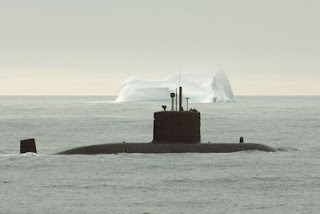
If the Nordic states gain significant control of Arctic oil and natural gas reserves, the European balance of power could shift further toward the West, a situation Russia is eager to prevent. Meanwhile, Canada, “alarmed by Russian adventurism in the Arctic,” has also strongly asserted its claims to Arctic sovereignty. “Canada has taken its sovereignty too lightly for too long,” said then-Prime Minister Stephen Harper in 2007. “This government has put a big emphasis on reinforcing, on strengthening our sovereignty in the Arctic.” Denmark, Great Britain, and Iceland, also mindful of the importance of Arctic resources, will likely stake claims to newly discovered resources. With the United States prepared to operate independently—at least according to the outgoing Bush administration—and its Arctic neighbors not likely to back away from their own interests, this once-frozen region could become a political hotspot.Photo: A Canadian naval submarine, the HMCS Corner Brook, patrols in Arctic waters as part of a Canada Command sovereignty operation in the Hudson Strait in August 2007. Courtesy of MCpl Blake Rodgers, Formation Imaging Services, Halifax, Nova Scotia, and flickr user lafrancevi.
-
Natural Gas Standoff Between Russia, Ukraine Brings New Meaning to “Cold War”
›January 15, 2009 // By Rachel WeisshaarAs the dispute between Russia and Ukraine over natural gas pricing and delivery heads into its second week, it has grown into a larger political standoff between the two countries. The Council on Foreign Relations’ Jeffrey Mankoff explains that the “background is a long-running dispute between Russia and Ukraine in terms of gas relationships over two things: One is over the price that Ukraine pays, and the second is over debt that Ukraine owes Russia for gas shipments in the past that it hasn’t paid for. There’s also a political subtext because Ukraine, since 2004, has had a government that is interested in pursuing integration with Euro-Atlantic institutions, including NATO.”
Europe receives one-fifth of its natural gas from Russia; Bulgaria, Slovakia, and other countries in Eastern and Southeast Europe have been particularly hard-hit by the shutdown. Russia and Ukraine agreed to resume natural-gas deliveries to Europe on Monday, but that EU-brokered agreement has fragmented, and the two countries continue to argue over which pipelines to use and how much gas to deliver. Russian Prime Minister Vladimir Putin and Ukranian Prime Minister Yulia Tymoshenko are scheduled to meet at an EU-sponsored summit on Saturday.
Natural resources are frequently involved when Russia makes international headlines. For instance, in August 2008, Russia and Georgia went to war over resource-rich, geopolitically strategic South Ossetia. In addition, in January 2006, Russia and Ukraine got into a similar dispute over natural gas—although that one did not last as long as the present one. It remains to be seen which side—if either—will benefit from the manipulation of natural resources in the current situation. -
‘miniAtlas’ Misses Opportunity to Map Environmental Causes of Conflict
›January 7, 2009 // By Will Rogers“Former UN Secretary-General Kofi Annan said that there can be no development without security—and no security without development,” says the miniAtlas of Human Security, a global atlas illustrating international and civil conflicts, as well as human rights abuses. The atlas explains that human security comprises the broader pillar of freedom from want (for basic necessities like food, water, shelter, education, employment, and health care) and the narrower pillar of freedom from violence. Although freedom from want is vital to sustainable development and long-term security, the atlas only maps instances where freedom from violence has been marred by inter- or intrastate conflict.
While the atlas openly admits its exclusion of the broader pillar of human security—which notably includes environmental issues—it nevertheless misses the opportunity to acknowledge that the environment can span both pillars of human security. Though the atlas notes that the environment can be used as a weapon of violence—by poisoning wells, for instance—it never explains the role of the environment as a cause of violent conflict—in land disputes, local conflicts over water, or by spurring climate change-induced migration.
The authors of the miniAtlas of Human Security argue that today, most violent conflicts are rooted in poverty and politics. “Poor countries, unlike rich ones, lack the resources to address the grievances that can spark armed uprisings,” the report explains, and “poor countries tend to have weak security forces and so find it difficult to deter rebellions and to crush those that cannot be deterred.” In addition, dictatorships and “anocracies—regimes that are neither dictatorships nor full democracies—are the most prone to armed conflict” and human rights abuses. Though generally speaking, both of these statements are true, there are other causes of violent conflict that are just as important and have serious implications for human security.
For instance, the environment has helped spark conflict in many parts of the world. Competition over natural resources—whether diamonds in Angola and Sierra Leone, timber in Liberia, or coltan in the eastern Democratic Republic of the Congo—has been a source of violent conflict between warlords, governments, and civilian populations. Getting policymakers to recognize that the environment is a cause of violent conflict is an essential step to preventing conflict, as well as conducting successful post-conflict environmental and disaster management. Until we recognize that the environment can increase the risk of violence, global security itself will suffer.
Photo: The Zambezi (Chobe) River borders eight African states: Angola, Botswana, Namibia, Malawi, Mozambique, Tanzania, Zambia, and Zimbabwe. In an effort to improve governance and prevent violent conflict from erupting, these eight states are working for the establishment of a commission to govern this vital water resource. Courtesy of Flickr user Mara 1. -
VIDEO: Crisis Management and Natural Resources Featuring Charles Kelly
›December 19, 2008 // By Wilson Center Staff“Governance is key. If you don’t have a competent government after the war, you’re not going to solve the problems that weren’t solved before the war because of incompetent governance,” said Charles Kelly at “Sustaining Natural Resources and Environmental Integrity During Response to Crisis and Conflict,” a November 12 event.
In this latest video from the Environmental Change and Security Program, Kelly discusses the importance of carefully planning and executing post-conflict environmental assistance, which can lead to renewed conflict if not implemented properly. He highlights ongoing post-conflict and disaster management operations in Sudan and Haiti, offering suggestions for the way forward.
 “The United States has broad and fundamental national security interests in the Arctic region and is prepared to operate either independently or in conjunction with other states to safeguard these interests,” states
  “
“

