
-
Interplays Between Demographic and Climatic Changes
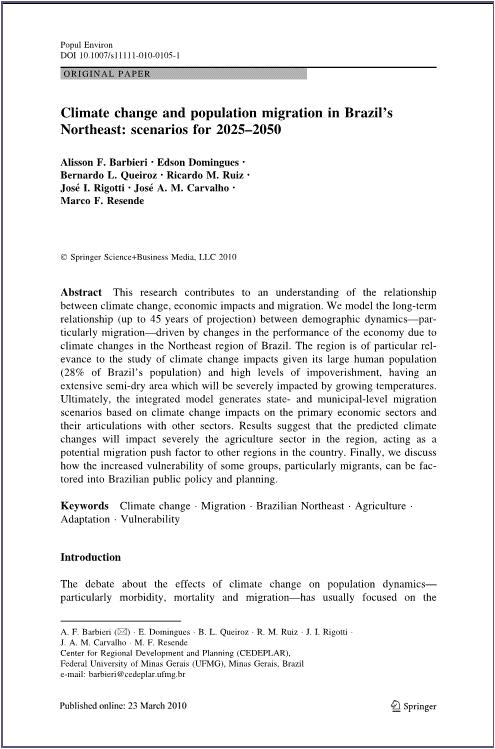
›“Impacts of Population Change on Vulnerability and the Capacity to Adapt to Climate Change and Variability: A Typology Based on Lessons from ‘a Hard Country,’” appearing in the journal Population and Environment, is a study of societal resilience by Robert McLeman from the University of Ottawa. Beginning with a literature review of the connections between population growth and greenhouse gas emissions, McLeman then details how demographic changes can negatively affect resilience–the ability of societies to cope and adapt to climate changes. Based on empirical studies of small communities undergoing local climate and demographic changes in eastern Ontario, McLeman finds that simultaneous demographic and climatic change “increased stress on local social networks…critical to climate adaptation.” “Climate Change and Population Migration in Brazil’s Northeast: Scenarios for 2025–2050,” also appearing in the journal Population and Environment, examines “demographic dynamics–particularly migration–driven by changes in the performance of the economy due to climate changes.” The region of study was chosen for its high levels of both population and poverty and its dry climate, “which will be severely impacted by growing temperatures.” The study concludes that predicted climate change impacts on agriculture are potential push migration factors and offers policy and planning recommendations to reduce migrant vulnerabilities.
Both articles are part of Population and Environment‘s special issue on “Climate Change: Understanding Anthropogenic Contributions and Responses.” -
As Somalia Sinks, Neighbors Face a Fight to Stay Afloat
›May 14, 2010 // By Schuyler NullThe week before the international Istanbul conference on aid to Somalia, the UN’s embattled envoy to the country, Ahmedou Ould-Abdallah, warned the Security Council that if the global community “did not take the right action in Somalia now, the situation will, sooner or later, force us to act and at a much higher price.”
The UN High Commission for Refugees (UNHCR) also issued strong warnings this week. Deputy High Commissioner Alexander Aleinikoff said in Geneva, “The displacement crisis is worsening with the deterioration of the situation inside Somalia and we need to prepare fast for new and possibly large-scale displacement.”
But the danger is not limited to Somalia. The war-torn country’s cascading set of problems – criminal, health, humanitarian, food, and environmental – threaten to spill over into neighboring countries.
A Horrendous Humanitarian Crisis
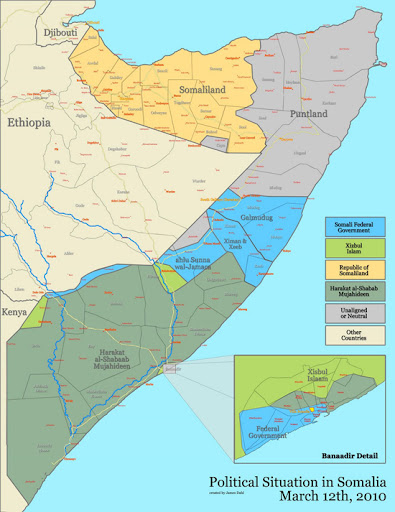
The UN- and U.S.-backed Transitional Federal Government (TFG) controls only parts of Mogadishu and small portions of central Somalia, while insurgent group Al Shabab controls nearly the entire south. The northern area is divided into semi-autonomous Somaliland and Puntland, which also fall outside of the transitional government’s control.
But the civil war is only one part of what Ould-Abdallah called a “horrendous” humanitarian crisis.
According to the UN, 3.2 million Somalis rely on foreign assistance for food – 43 percent of the population – and 1.4 million have been internally displaced by war. Another UN-backed study finds that approximately 50 percent of women and 60 percent of children under five are anemic. Most distressing, the UN Security Council reported in March that up to half of all food aid sent to Somalia is diverted from people in need by militants and corrupt officials, including UN and government employees.
Because of the country’s large youth bulge – 45 percent of Somalia’s population is under the age of 15 – food and health conditions are expected to get much worse before they get better. In the 2009 Failed States Index, Somalia ranks as the least stable state in the world and, along with Zimbabwe, has the highest demographic pressures.
Islamic Militants and the Battle for the High Seas
Yet the West continues to focus on the sensational pirate attacks on Somalia’s coast. The root cause of these attacks is not simply lawlessness say Somali officials, instead, they began partly as desperate attempts to stop foreign commercial fleets from depleting Somalia’s tuna-rich, lawless shores. A 2006 High Seas Task Force reported that at any given time, “some 700 foreign-owned vessels are engaged in unlicensed and unregulated fishing in Somali waters, exploiting high value species such as tuna, shark, lobster and deep-water shrimp.”
The transitional government opposes the fishermen-turned-pirates, but can do little to stop them. Al Shabab has thus far allowed pirates to operate freely in their territory. Their tacit approval may be tied to reports that the group has received portions of ransoms in the past.
Another hardline Islamist group, Hizbul Islam, recently took over the pirate safe haven of Haradhere, allegedly in response to local pleas for better security, but the move may simply have been part of an ongoing struggle with Al Shabab for control of pirate ransoms and port taxes – one of the few sectors of the economy that has remained lucrative.
“I can say to you, they are not different from pirates — they also want money,” Yusuf Mohamed Siad, defense minister with Somalia’s TFG, told Time Magazine.
A Toxic ThreatInitially the pirates claimed one of their goals was to ward off “mysterious European ships” that were allegedly dumping barrels of toxic waste offshore. UN envoy Ould-Abdallah told Johann Hari of The Independent in 2009 that “somebody is dumping nuclear material here. There is also lead, and heavy metals such as cadmium and mercury – you name it.” After the 2005 tsunami, “hundreds of the dumped and leaking barrels washed up on shore. People began to suffer from radiation sickness, and more than 300 died,” Hari reports.
Finnish Minister of Parliament Pekka Haavisto, speaking to ECSP last year, urged UN investigation of the claims. “If there are rumors, we should go check them out,” said the former head of the UN Environment Program’s Post-Conflict Assessment Unit:I think it is possible to send an international scientific assessment team in to take samples and find out whether there are environmental contamination and health threats. Residents of these communities, including the pirate villages, want to know if they are being poisoned, just like any other community would.
To date, there has been no action to address these claims.
Drought, Deforestation, and Migration
While foreign entities may have been exploiting Somalia’s oceans, the climate has played havoc with the rest of the country. Reuters and IRIN report that the worst drought in a decade has stricken some parts of the interior, while others parts of the country face heavy flooding from rainfall further upstream in Ethiopia.
Land management has also broken down. A 2006 Academy for Peace and Development study estimated that the province of Somaliland alone consumes up 2.5 million trees each year for charcoal, which is used as a cheaper alternative to gas for cooking and heating. A 2004 Somaliland ministry study on charcoal called the issue of deforestation for charcoal production “the most critical issue that might lead to a national environmental disaster.”
West of Mogadishu, Al Shabab has begun playing the role of environmental steward, instituting a strict ban on all tree-cutting – a remarkable decree from a group best known for their brutal application of Sharia law rather than sound governance.
The result of this turmoil is an ever-increasing flow of displaced people – nearly 170,000 alone so far this year, according to the Washington Post – driven by war, poverty, and environmental problems. The burden is beginning to weigh on Somalia’s neighbors, says the UNHCR.
The Neighborhood Effect
One of the largest flows of displaced Somalis is into the Arabian peninsula country of Yemen – itself a failing state, with 3.4 million in need of food aid, 35 percent unemployment, a massive youth bulge, dwindling water and oil resources, and a burgeoning Al Qaeda presence.
In testimony on Yemen earlier this year, Assistant Secretary of State Jeffrey Feltman said that the country’s demographics were simply unsustainable:Water resources are fast being depleted. With over half of its people living in poverty and the population growing at an unsustainable 3.2 percent per year, economic conditions threaten to worsen and further tax the government’s already limited capacity to ensure basic levels of support and opportunity for its citizens.
Other neighboring countries face similar crises of drought, food shortage, and overpopulation – Ethiopia has 12 million short of food, Kenya, 3.5 million, says Reuters. UNHCR reports that in Djibouti, a common first choice for fleeing Somalis, the number of new arrivals has more than doubled since last year, and the country’s main refugee camp is facing a serious water crisis.
A Case Study in Collapse
The ballooning crises of Somalia encompass a worst-case scenario for the intersection of environmental, demographic, and conventional security concerns. Civil war, rapid population growth, drought, and resource depletion have not only contributed to the complete collapse of a sovereign state, but could also lead to similar problems for Somalia’s neighbors – threatening a domino effect of destabilization that no military force alone will be able to prevent.
Speaking at a naval conference in Abu Dhabi this week, Australian Vice Admiral Russell Crane told ASD News that, “The symptoms (piracy) we’re seeing now off Somalia, in the Gulf of Aden, are clearly an outcome of what’s going on on the ground there. As sailors, we’re really just treating the symptoms.”
Sources: Academy for Peace and Development, AP, ASD News, Carnegie Endowment for International Peace, Christian Science Monitor, Foreign Policy, High Seas Task Force, Independent, IRIN, New York Times, Population Action, Population Reference Bureau, Reuters, Telegraph, Time, UN, US State Department, War is Boring, Washington Post.
Photo Credits: “Don’t Swim in Somalia (It’s Toxic)” courtesy of Flickr user craynol and “Somalia map states regions districts” courtesy of Wikimedia Commons. -
DOD Measures Up On Climate Change, Energy
›May 5, 2010 // By Schuyler Null“As Congress deliberates its role, DOD is moving ahead steadily on a broad range of energy and climate initiatives,” says former Senator John Warner in a recent Pew report, Reenergizing America’s Defense: How the Armed Forces Are Stepping Forward to Combat Climate Change and Improve the U.S. Energy Posture.
The military as a leader and catalyst for renewable energy was a key focus of the recently released Quadrennial Defense Review (QDR), which for the first time included consideration of the effects of climate change and excessive energy consumption on military planning:Assessments conducted by the intelligence community indicate that climate change could have significant geopolitical impacts around the world, contributing to poverty, environmental degradation, and the further weakening of fragile governments. Climate change will contribute to food and water scarcity, will increase the spread of disease and may spur or exacerbate mass migration.
According to the Pew report, the Department of Defense has set a goal of producing or procuring at least 25 percent of its non-tactical electric energy needs from renewable sources by 2025. Highlights of the service’s efforts include:
The Pew report offers a generally favorable appraisal of the military’s response to the “twin threats of energy dependence and climate change” and the progress made towards reaching federal energy mandates. However, the authors let slide that the overwhelming amount of DOD energy usage is tied to tactical consumption, which has been given inadequate attention thus far (consider that the senior Pentagon official overseeing tactical energy planning was only just appointed, although the position has existed since October 2008).- The U.S. Navy’s “Great Green Fleet” carrier strike group, which will run entirely on alternative fuels and nuclear power by 2016;
- The construction of a 500-megawatt solar facility in Fort Irwin, California by the U.S. Army which will help the base reach ‘net-zero plus’ status;
- The goal of acquiring 50 percent of the U.S. Air Force’s aviation fuels from biofuel blends by 2016;
- The U.S. Marine Corps’ 10×10 campaign to develop a comprehensive energy strategy and meet ten goals aimed at reducing energy and water intensity and increasing the use of renewable electric energy by the end of 2010.
Interest in this field has grown quickly, as evidenced by the more than 400 people gathered at the launch of the latest report from the Center for New American Security (CNAS), Broadening Horizons: Climate Change and the U.S. Armed Forces – a big increase from the 50 or so at CNAS’ first natural security event in June 2008.
The CNAS study, much like the Pew report, breaks down the military’s efforts by service, but the study’s authors – including U.S. Navy Commander Herbert E. Carmen – thankfully provide more specific recommendations for what could be done better.
Based on research, interviews, and site visits, the study offers geographically specific recommendations for each of the Unified Commands, as well as seven broad recommendations for DOD as a whole:
“While we believe there is still much work ahead, there is a growing commitment to addressing energy and climate change within the DOD,” said USN Commander Carmen in the report:- In light of its implications for the global commons, ensure that DOD is included in the emerging debate over geoengineering.
- Urge U.S. ratification of the UN Convention on the Law of the Sea in order to provide global leadership and protect U.S. and DOD interests, especially in the context of an opening Arctic sea.
- Eliminate the divided command over the Arctic and assign U.S. Northern Command (NORTHCOM) as the supported commander.
- The U.S. government should make an informed decision about constructing nuclear reactors on military bases and provide clear policy guidelines to DOD.
- Congress and DOD should move away from the “cost avoidance” structure of current renewable energy, conservation, and efficiency practices in order to reward proactive commanders and encourage further investment.
- All of the services should improve their understanding of how climate change will effect their missions and capabilities; e.g. migration and water issues may impact Army missions, a melting Arctic, the Navy.
- The Air Force should fully integrate planning for both energy security and climate change into a single effort.
Indeed, in our conversation with officials in the Office of the Secretary of Defense for Policy, it was clear that, in developing the climate change and energy section of the 2010 QDR, the Department of Defense has developed a nascent, intellectual infrastructure of civilian and military professionals who will continue to study the national security implications of climate change, and, we hope, will continue to reevaluate climate change risks and opportunities as the science continues to evolve.
A holistic view of national security that includes energy and environment, as well as demographic and development inputs, continues to gain traction as an important driver in DOD policy and planning.
Photo Credit: “Refueling at FOB Wright” courtesy of Flickr user The U.S. Army. -
The Plight of Urban Refugees in Nairobi
›“The Traditional image of life in tented sprawling camps no longer tells the full refugee story.”– Hidden and Exposed: Urban Refugees in Nairobi, Kenya
Coinciding with the end of UN-HABITAT’s 5th World Urban Forum, a new report and associated video, Hidden and Exposed: Urban Refugees in Nairobi, Kenya, have been released by the Humanitarian Policy Group (HPG) at the Overseas Development Institute (ODI) and the International Rescue Committee (IRC).
Hidden and Exposed removes the cloak of migration stereotypes and provides an unfiltered look at urban migrants’ struggle for daily survival. Focusing on seven neighborhoods with high refugee concentrations in Nairobi, the authors — through qualitative interviews and secondary data — found a unique, challenging urban environment for thousands of refugees. Aid and development groups often overlook these urban refugees, instead favoring work with traditional established camps on the urban periphery.
The HPG found that Nairobi’s 46,000 registered refugees represent a diverse mix of ethnic groups and nationalities, all trying to secure economic independence and security. While much research has been devoted to the traditional concept of displaced migrants in centralized ex-urban camps, such as Dadaab in Eastern Kenya, urban dwellers are just as vulnerable to insecurity, poverty, and harassment. With nebulous legal rights, facing discrimination and protected by only fragile support systems, the refugee community in Nairobi finds itself in a precarious situation.
In light of the challenges, the research team at HPG offered three basic recommendations as initial steps:
1. Protection:
2. Livelihoods:- Address confusion over legal rights to prevent issues of police harassment and community violence.
- Target a subset of donor funds for training local police forces and government agencies.
- Establish partnerships between the UNHCR and the Kenyan government to improve the latter’s Refugee Status Determination System.
- Funnel humanitarian and development aid toward legal aid services while also using innovative strategies to increase dialogue between urban refugees and the surrounding Kenyan communities.
3. Service Delivery:- Carry out surveys to better understand the Nairobi urban economy, including the informal sector.
- Support the government of Kenya in their efforts to help urban refugees to become self-reliant.
- Recognize the transition of refugees from sequestered camps to urban areas and develop an effective response.
- Secure Kenyan government permission for the issuance of work permits for refugees.
Fleeing conflict and attracted by the possibility of better jobs, services, or security, thousands of refugees have sought new lives in Nairobi. Yet the reality for many urban migrants is an existence burdened with inadequate assistance, a precarious legal status, and economic and physical insecurity. Through the implementation of these recommendations, HPG hopes to draw attention to these hidden refugees, and offer them the hope of improved livelihoods and effective security.- Design aid models to address the unique challenges faced by urban refugees in Nairobi.
- Ensure coordinated and comprehensive services, in conjunction with the Kenyan government and international organizations, to address the needs of the urban refugees and the surrounding communities, with particular attention granted to refugee women and girls.
-
Megatrends: Embracing Complexity in Today’s Population and Migration Challenges
›March 29, 2010 // By Geoffrey D. DabelkoForeign Policy’s Elizabeth Dickinson recently sat down with UN High Commissioner for Refugees António Guterres for a wide-ranging interview on the global refugee crisis. Yet a strong theme emerges across the continents: The complexity of today’s conflicts belies either easy or quick solutions.
-
A Forecast of Push and Pull: Climate Change and Global Migration
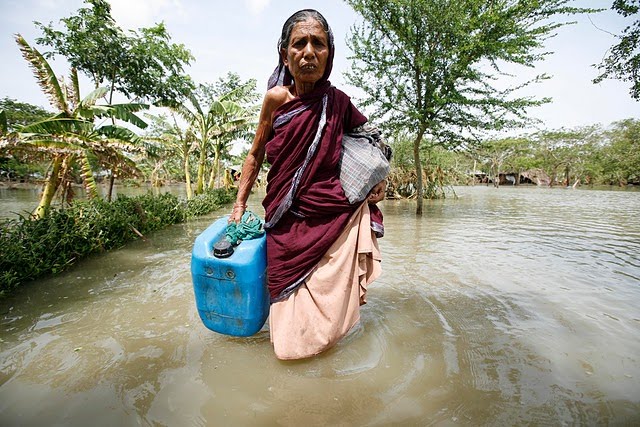
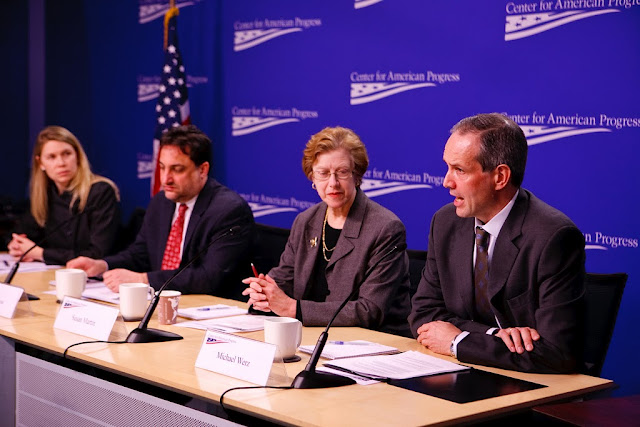
›March 10, 2010 // By Julien Katchinoff“As we …talk about the interconnections between climate change and migration we need to look at the interconnections in a way that understands what’s positive about the processes of migration and what’s problematic,” said Susan Martin, Herzberg Professor of International Migration at Georgetown University, during a recent event on climate and migration at the Center for American Progress.
Susan Martin joined Cynthia Brady, senior conflict advisor for the Office of Conflict Management and Mitigation at USAID and David Waskow, director of the Climate Change Program at Oxfam America, to identify the catalysts for future population flows, offer pragmatic policy solutions, and discuss work to be done on the ground.
While reminding the audience that climate-induced migration will tend to follow already existing patterns, Susan Martin broadly outlined four major intersections between migration and climate change impacts:
“Slow” Migration Pressures:- Drought or desertification resulting in a loss or depreciation of livelihoods.
Result: Push working family members to migrate to domestic or international urban centers. - Rising sea levels damaging fishing and agriculture opportunities.
Result: Migration to inland regions to reduce future risk.
“Rapid” Migration Pressures:- Intensification of natural disasters and damage to infrastructure.
Result: The coping costs increase to the point where they push large numbers of people to leave their homes. Most individuals migrate internally. Of the four intersections, this is currently the most common. - Threats to the availability of food, water, and other natural resources.
Result: Low or high intensity conflict, leading to migrations. The short timeframes and potentially large numbers of migrants involved make this driver the most problematic. Differing degrees of internal political stability are factors that can interfere for better or worse.
Yet these relationships are not without controversy. “Environmentalists have tended to see the issue of migration as a way of getting attention to mitigation and have often talked about migration in very alarmist terms,” Martin said. “Migration experts, on the other hand, have been very skeptical about the interconnection.” Instead, they have argued that other push and pull factors outside of climate are much more significant to the migration calculation.
Operating from the perspective that migration itself is an adaptation failure, David Waskow outlined several strategies that Oxfam deploys to help communities copewith uncertain futures:
- Building climate resilience and developing adaptation strategies: Proactive approaches are essential, as agencies and communities can address future threats with disaster planning and creating early-warning systems.
- Managing risk: The establishment of micro-insurance projects can cushion vulnerable populations against unexpected economic shocks.
- Resettling communities: The movement of rural populations to urban areas could result in tensions over land use and strains on urban governance and carrying capacities. As a result, this approach is left as a last recourse.
Brady, though in agreement with Waskow concerning climate change’s threat to livelihoods and its role as a catalyst for conflict, suggested that there may be positive opportunities for managing climate risks. “The environment can and does provide an essential and effective platform for dialogue, communication, and confidence-building around shared interests,” Brady said. “It may be that certain conflicts actually lend themselves to the use of climate-related collaboration as a mechanism to resolve conflict or reduce tension between parties,” she said.
Climate-related projects at the community-level, from adaptive early-warning systems to mitigating carbon storage schemes, hold the possibility to bring groups together in cooperative projects, build confidence, and defuse existing tensions. Transparent and participatory management of new investments may also increase trust in local and national governments with whom trust was previously lacking. While forestalling crises in the future, adaptation projects also hold the potential to unlock opportunities for peacebuilding and conflict resolution today.
Photo Credits: Photo 1 courtesy Oxfam America. Photo 2 courtesy Center for American Progress. - Drought or desertification resulting in a loss or depreciation of livelihoods.
-
Healing the Rift: Mitigating Conflict Over Natural Resources in the Albertine Rift
›March 2, 2010 // By Dan AsinConservation practitioners realize they must deal with conflict but often lack the training to do so, says Dr. Andrew Plumptre, director of the Wildlife Conservation Society’s (WCS) Albertine Rift Program. Moreover, they don’t realize their conservation efforts—by restricting access to resources or creating new burdens, costs, and risks for communities—are at times directly responsible for spawning new conflicts where none existed before.
In a recent presentation—Healing the Rift: Mitigating Conflict Over Natural Resources in the Albertine Rift, sponsored by WCS and the Africa Biodiversity Collaborative Group—Plumptre used his work with WCS in the Albertine Rift as a launch pad to discuss how conservation practitioners can work to mitigate conflict.
Achieving “Conflict-Sensitive Conservation”
“Conflict-sensitive conservation,” as outlined in an International Institute for Sustainable Development‘s practitioners’ manual developed in conjunction with WCS, is a multi-step process:- Identify—What are the area’s current or potential conflicts?
- Prioritize—Which conflicts are the most serious?
- Target—Which high-risk conflict does my organization possess the capacity to address?
- Analyze—What are the causes and effects of conflict? Who are the stakeholders, what are the relationships between them, and which should we seek to engage?
- Design & implement solutions—With what strategy should the conflict be approached? At which point in the conflict cycle should we seek to intervene?
- Monitor—Continue to watch the area for new developments.
Plumptre’s fieldwork on the DRC’s Virunga National Park is one of the case studies in Renewable Natural Resources: Practical Lessons for Conflict-Sensitive Development, recently published by the World Bank. Conflict in the park began in 1996, when an influx of internally displaced persons from the war in the DRC poured into the area, placing severe strains on the park’s fish, wildlife, timber, and agricultural resources.
In 2006, Plumptre and his WCS colleagues entered Virunga and identified four challenges they could best address:- Overfishing on Lake Edward
- Military poaching
- Park encroachment
- Conflict with displaced Ugandan pastoralists
- To combat overfishing, WCS helped villages establish sustainable targets and implement internal policing mechanisms
- To curtail encroachment and poaching by the military and those living in the greater Virunga National Park area, WCS trained Congolese Park Authority (ICCN) staff in enforcement and monitoring techniques, established channels of communication with military commanders, and engaged in general and targeted environmental educational campaigns.
- To relieve resource pressures from the presence of Ugandan pastoralists, WCS worked with the Congolese and Ugandan governments to ensure pastoralists could safely and freely return to Uganda to settle elsewhere.
Beyond Virunga National Park
Since completing their project in 2007, Plumptre and his team have established similar projects in Kahuzi-Biega National Park, the Itombwe Massif, and Misotshi-Kabogo. Now, however, they are working to prevent conflicts before they take root. WCS has guided communities in the Misotshi-Kabogo area to work together to petition the Congolese government to turn their territory into the DRC’s 8th national park.
Climate change is predicted to spur local, often intra-state or regional, migrations in response to droughts and flooding. Could these migrations lead to similar resource conflicts in the future? The rate of migration, governance and carrying capacities of the absorbing communities, and economic status of the migrants will all come in to play. In cases where conflict might result, Plumptre’s work successfully demonstrates that “conflict-sensitive conservation” should have a place in the peacebuilders’ toolkit. -
Climate Reporting Awards Live From COP; Revkin To Quit NYT
›It’s a good news/bad news day for climate-media watchers. The Earth Journalism Awards honor some of the best climate coverage from around the world, while arguably the world’s most respected climate reporter announces he’s leaving journalism.
Earth Journalism Awards
Tune in now to watch the Internews Earth Journalism Awards webcast live from Copenhagen. The spectacularly impressive winning entries span the globe from Kenya, Brazil, Pakistan, and Papua New Guinea.
Two top-notch stories illustrate how nuanced, in-depth reporting can compellingly and accurately portray climate-security links: Lisa Friedman’s 5-part series on Bangladesh for ClimateWire untangles the knotty problem of climate-induced migration, while William Wheeler writes in GOOD Magazine about the increasingly difficult role of Indus Water Treaty in mitigating conflict between India and Pakistan.
The 15 winners are blogging from the summit, as well 40 reporters from 26 developing nations, as part of the Climate Change Media Partnership.
Revkin Frustrated With Journalism; Will Leave NYT
On the bad news side, Yale Forum on Climate Change and Media announced this morning that Andrew Revkin, the NYT’s climate reporter, will leave the paper on December 21. He cites “frustration with journalism,” but will continue writing his popular DotEarth blog.
Maybe Revkin’s frustration is with the disintegration of environmental coverage in the mainstream media? The Internews winners demonstrate the high quality of climate coverage at niche publications like ClimateWire or funded by non-profits like the Pulitzer Center on Crisis Reporting.
Let’s hope Revkin finds a more comfortable home and continues his pioneering work on DotEarth, specifically his efforts to cover population, poverty, consumption, and development connections to climate.
Showing posts from category migration.